The Art of Love by Ovid — The Roman Poet Who Got Himself Banished for Writing It | Retrosheep
Ovid | Art of Love
THE ART OF LOVE BY OVID
A BOOK THAT SCANDALISED AN EMPEROR AND OUTLASTED AN EMPIRE
Most books, if they're lucky, get a decent review in a newspaper and sell a few hundred copies. Some get shortlisted for prizes. A very select few change the cultural landscape of their era and remain in print for centuries.
And then there's The Art of Love by Ovid — a book so audacious, so wickedly funny, and so comprehensively inappropriate for the political climate it was published in, that the Roman Emperor Augustus personally had it banned and used it as partial justification for exiling its author to the edge of the known world, where he died alone, far from Rome, never to return.
Two thousand years later, it's still in print. Augustus is not.
We have a genuinely beautiful edition of it right here at Retrosheep — a Folio Society hardcover in cream cloth with a burgundy slipcase, illustrated throughout, translated with great wit and energy by James Michie, in used like new condition for £24.99. But before we get to the book itself, let's talk about the man who wrote it, because the life of Publius Ovidius Naso is one of the most fascinating, dramatic, and frankly baffling stories in the entire history of literature.
👉 retrosheep.com/shop/p/ovid-artoflove
WHO WAS OVID? A BRIEF AND VERY ENTERTAINING HISTORY
Publius Ovidius Naso — Ovid to his friends, which was everyone, because Ovid was enormously charming — was born on the 20th of March, 43 BC, in Sulmo, a small town in the Apennine mountains about 90 miles east of Rome. He was born into a wealthy equestrian family, the kind of comfortable upper-middle-class background that was expected to produce solid, reliable public servants who would go into law or government and do nothing embarrassing.
His father had exactly this plan. Ovid was sent to Rome to be educated in rhetoric — the essential skill for a career in law or politics — and showed considerable natural ability. He then went on to Athens for further study, as was fashionable among ambitious young Romans of his class. He held a series of minor judicial positions. It genuinely seemed, for a moment, that he might become a perfectly ordinary and entirely forgettable Roman bureaucrat.
Except that he couldn't stop writing poetry.
Poetry kept getting in the way. It was always poetry. He tried the law, he tried the career track, but the poems just kept coming — and they were very, very good. Witty, technically brilliant, emotionally perceptive, and frequently scandalous. His father famously complained about the whole business. Ovid's reported response to his father's objection that poetry made no money was to point out that Homer himself made no money, and Homer was doing rather well two thousand years after the fact. He had a point.
By his mid-twenties, Ovid had abandoned any pretence of a legal career and was producing poetry full-time. His early work — the Amores, a collection of love elegies — established him as one of the great voices of his generation. Rome was at the height of its Augustan golden age. Virgil was writing the Aeneid. Horace was composing his Odes. And Ovid was writing witty, irreverent love poetry that bore about the same relationship to Virgil's solemn epic nationalism as a cheeky stand-up comedian bears to a state funeral.
He was extremely popular. He was the talk of Rome. He was, by any measure, a success.
Then he wrote The Art of Love. And everything went wrong.
THE ART OF LOVE — WHAT IT ACTUALLY IS
The Ars Amatoria — The Art of Love — was written around 2 BC and is one of the most unusual works in classical literature. It is a didactic poem, meaning it's written in the tradition of instructional poetry — the same genre as Virgil's Georgics, which teaches farming, or Lucretius's De Rerum Natura, which teaches Epicurean philosophy. Didactic poetry was a serious, respectable genre.
Ovid used it to write a manual on seduction.
In three books of elegant elegiac couplets, Ovid provides comprehensive, witty, and completely deadpan advice on how to find a partner, how to win them over, and — in the third book, which he added somewhat mischievously — how women should pursue men in return. The advice is by turns practical, absurd, knowing, and extraordinarily modern in tone. He recommends attending the theatre and the circus as good places to meet people. He discusses the importance of good personal hygiene. He advises against being too eager, against showing all your cards at once, against making promises you won't keep. He is, essentially, writing a relationship guide two millennia before the self-help section of Waterstones existed.
And throughout, he maintains a tone of perfectly judged irony — the mock-serious voice of a man dispensing life wisdom with a completely straight face while the entire poem winks at you. This is the joke. The Art of Love is a parody of didactic poetry, but it's also a genuinely good relationship guide, but it's also a comedy, but it's also a remarkably acute observation of Roman social life. All of these things are simultaneously true, which is part of what makes it so remarkable.
Emperor Augustus, who was at the time running a public moral reform campaign and trying to encourage Roman citizens to marry, have children, and generally conduct themselves with dignity, did not find it funny. At all.
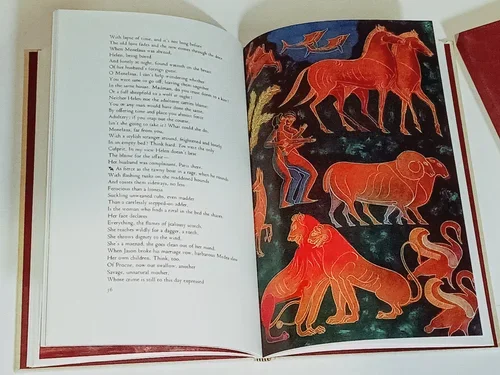
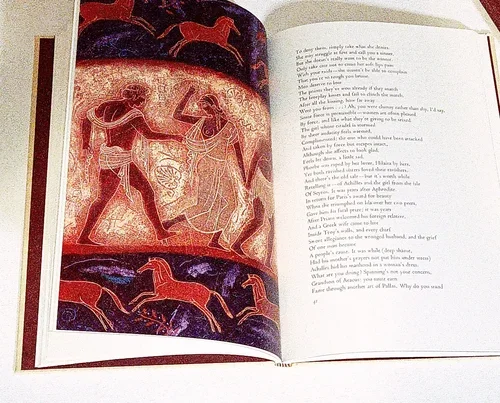
Take a look Inside the Book
THE EXILE — WHEN A POEM ENDS YOUR CAREER AND YOUR LIFE
In 8 AD — roughly a decade after The Art of Love was published — Augustus banished Ovid to Tomis, a remote outpost on the western shore of the Black Sea, in what is now Romania. This was not a comfortable exile. Tomis was cold, provincial, linguistically alien (Ovid spoke no Getic, the local language), culturally barren by Roman standards, and about as far from the sophisticated literary and social world of Rome as it was possible to get while remaining within the empire.
Ovid himself was never entirely clear about the exact reasons for the exile. In his subsequent works — particularly the Tristia and the Epistulae ex Ponto, collections of letters and poems written from exile — he refers somewhat evasively to a poem and a mistake. The poem was almost certainly The Art of Love. The mistake remains genuinely mysterious, though it may have been connected to a scandal involving Augustus's granddaughter Julia, who was exiled in the same year for reasons that were also never fully explained.
What is clear is that Ovid spent the rest of his life in Tomis, writing increasingly desperate letters to friends and patrons in Rome begging for intercession, composing poetry about the misery of exile with the same technical brilliance he'd applied to everything else, and never once being permitted to return. Augustus died in 14 AD. His successor Tiberius showed no interest in recalling Ovid either. Ovid died in Tomis around 17 or 18 AD, having spent roughly a decade in exile. He was in his early sixties.
The ending is genuinely sad. But the work he left behind was already immortal.
OVID'S OTHER WORKS — THE REST OF THE STORY
The Art of Love is the most notorious of Ovid's works but far from the only remarkable thing he produced. His output was extraordinary in both volume and variety.
The Metamorphoses, completed just before his exile, is considered his masterpiece — an epic poem in fifteen books retelling over two hundred myths and legends from classical antiquity, all connected by the theme of transformation. It runs from the creation of the world through to the deification of Julius Caesar. The Metamorphoses is one of the single most influential works in western literature, period. Without it, Chaucer, Shakespeare, Milton, Dante, Keats, and hundreds of other major writers would look significantly different. Shakespeare drew on it repeatedly — A Midsummer Night's Dream, The Tempest, and Titus Andronicus all lean on Ovidian material. The myths of Narcissus, Daphne, Orpheus and Eurydice, Pygmalion, and Actaeon — the versions that actually entered the popular imagination and influenced western art — all come from the Metamorphoses.
The Heroides are verse letters written in the voices of legendary heroines — Penelope to Ulysses, Dido to Aeneas, Medea to Jason — examining the stories of classical mythology from the perspectives of the women who were usually marginalised within them. This is a genuinely radical idea for ancient literature and makes Ovid feel startlingly contemporary.
The Fasti is a calendar poem describing the festivals and mythology of the Roman year, of enormous value to historians of Roman religion and culture.
And the exile works — the Tristia and Epistulae ex Ponto — are among the most emotionally raw and personally revealing works of classical poetry, a man of enormous wit and social grace stripped of everything he valued and writing through the cold and the isolation with undiminished technical mastery.
Ovid contains multitudes. He is funny and melancholy, irreverent and earnest, politically outrageous and technically impeccable. He is, in short, one of the greatest writers who ever lived. Augustus banned one of his books, exiled him, and died. We're still reading Ovid.
THE FOLIO SOCIETY EDITION — ABOUT THIS SPECIFIC BOOK
Now. The book we actually have in the shop.
This is the Folio Society edition of The Art of Love, fifth printing of the 1993 edition, translated by James Michie and illustrated by Grahame Baker. The Folio Society, for those unfamiliar, is a British publisher founded in 1947 with a specific mission: to produce beautiful editions of great literature, properly bound, properly illustrated, properly made. Folio Society books are not mass-market paperbacks. They are objects of beauty as well as texts, designed to be kept, displayed, and read with pleasure over many years.
This particular edition is bound in cream cloth with a gilt-lettered spine — elegant, tactile, the kind of book that sits well on a shelf and feels substantial and pleasurable in the hands. The text is accompanied throughout by the illustrations of Grahame Baker, which are bold, playful, and — entirely appropriately given Ovid's subject matter — occasionally quite daring. They capture the spirit of the text perfectly: sophisticated, witty, and not taking itself entirely seriously.
James Michie's translation is excellent. Rendering Ovid into English is a significant challenge — the elegiac couplet is a very specific metre that doesn't map naturally onto English verse, and Ovid's wit is closely tied to the compressed elegance of his Latin. Michie solves this with jaunty rhyming couplets that give the English version real snap and energy, preserving the comedy and the lightness while remaining faithful to the meaning. It is the kind of translation that makes the original accessible without dumbing it down.
The condition is used — like new. The book itself is pristine, unread, pages in perfect condition. The outer burgundy slipcase has minor silvering marks from normal handling over time, exactly as shown in our photos. We don't hide wear. What you see is what you get.
This is a fifth printing of the 1993 Folio Society edition. It is not the first printing — collectors after the earliest issue should note that — but as a reading and display copy it is in outstanding condition and represents tremendous value at £24.99. A new Folio Society edition of comparable quality would cost you significantly more than this.
WHO IS THIS BOOK FOR?
Anyone who loves classical literature and wants a genuinely beautiful edition rather than a utilitarian paperback. Anyone who is building a collection of fine press books. Anyone who wants to understand where a significant strand of western literary wit — sharp, ironic, knowing, sensual — actually comes from. Anyone who enjoys a book that has history attached to it: this is a work that got its author exiled by an emperor and outlasted both the emperor and the empire.
It would make an exceptional gift for someone interested in classics, poetry, Roman history, or the history of literature. It is the kind of book that sits on a shelf and makes a statement about the person who owns it — that they have taste, a sense of humour, and a healthy disregard for the kind of literary prudishness that made Augustus reach for the banishment papers.
There is only one. When it's gone, it's gone.
👉 Grab it here: retrosheep.com/shop/p/ovid-artoflove — £24.99, ships from South Wales via Royal Mail Tracked.
A FINAL NOTE ON OVID AND RELEVANCE
It would be easy to treat The Art of Love as a historical curiosity — a clever Roman party trick, impressive in its technical execution but ultimately a product of a world two millennia removed from our own. This would be entirely wrong.
The observations Ovid makes about human behaviour in pursuit of love — the vanity, the calculation, the self-delusion, the genuine tenderness lurking underneath the game-playing, the comedy of two people trying to impress each other while pretending they're not — are not observations about Romans. They are observations about people. They were true in 2 BC. They were true in 1993 when James Michie translated this edition. They are true in 2026.
Ovid understood something that very few writers in any era fully grasp: that love is simultaneously the most serious and the most ridiculous thing human beings do. That you can write about it with complete sincerity and complete comedy in the same couplet, and both will be true. That the gap between how we present ourselves in pursuit of love and how we actually feel is the richest possible source of material for a poet.
He was right about all of it. Augustus should have just laughed.

A beautiful Folio Society edition of Ovid's Ars Amatoria one of the most witty, provocative and enduring works of classical literature in used like new condition.
Written by the Roman poet Ovid around 2 BC and promptly scandalising the Emperor Augustus, The Art of Love is a mock-instructional poem on the pursuit of romance and seduction. It is sharp, funny, surprisingly modern in tone, and utterly unlike anything else from antiquity. James Michie's translation captures all of that energy brilliantly rendered in jaunty rhyming couplets that give the text a lightness and wit perfectly suited to the original.
This Folio Society edition is a genuinely beautiful object. The text is accompanied throughout by the bold, playful illustrations of Grahame Baker elegant and occasionally daring, very much in the spirit of Ovid himself. The book is bound in cream cloth featuring a gilt-lettered spine, and comes complete with its coordinating burgundy slipcase, which remains in excellent shape.
This is a fifth printing of the 1993 Folio Society edition a handsome addition to any collection of fine press books or classical literature.
Condition: Used like new. Unread, pages pristine. The outer slipcase has minor silvering marks from handling over time, as shown in the photos. The book itself is in excellent condition throughout.
Book Details:
Author: Ovid
Translator: James Michie
Illustrator: Grahame Baker
Publisher: The Folio Society
Edition: Fifth printing, 1993
Binding: Cream cloth hardcover with burgundy slipcase
Language: English
The Art of Love by Ovid — Folio Society Edition | Illustrated | Slipcase | Used Like New£24.99 | Limited Availability | Ships UK via Royal Mail Tracked from South Wales👉 retrosheep.com/shop/p/ovid-artoflove
Delivery: Royal Mail Fixed Rates — UK Standard £3.60 Tracked 48hr.Payments: PayPal (recommended). Credit & Debit Cards via Stripe.
Retrosheep — Handmade in Wales since 2006. Blackwood, South Wales.retrosheep.com/shop/books-magazines