Ink, Steel and Immortality — A Collector's Love Letter to Japanese Manga and the Art of Hiroaki Samura
I remember the first time I truly stopped and looked at a page of manga — not just read it, but really looked at it. The linework. The way a single brush stroke could carry the weight of an entire emotion. The way negative space and shadow were used with a confidence and economy that most Western artists spend decades trying to achieve. I sat there and thought: this is extraordinary. This is one of the great art forms of the modern world, and most people are walking past it without a second glance.
That was the moment I became a collector.

A Collector's Love Letter to Japanese Manga and the Art of Hiroaki Samura.png
I am not just someone who reads manga. I am someone who preserves it. I seek out first editions, mint condition copies, books that have never been cracked open, never been creased, never been exposed to the slow damage of time and careless handling. I collect manga the way others collect rare paintings or first edition novels — because I believe these objects have genuine cultural and artistic value that deserves to be protected and passed on.
And right now, in my collection, I have something I am genuinely proud of: a near-complete run of Blade of the Immortal by Hiroaki Samura, 1st edition, brand new and mint, published by Dark Horse Comics. Volumes 1 through 14, preserved and available for the next generation of collectors and readers who understand what they are looking at.
But before I get to that, let me tell you where manga comes from. Because to truly appreciate what you are holding when you pick up a volume of Japanese manga, you need to understand the centuries of artistic tradition that produced it.
The Ancient Roots: Where Manga Begins
The word manga — 漫画 — is often translated as whimsical pictures or informal pictures. It was popularised as a term by the great woodblock print artist Katsushika Hokusai in 1814, who used it as the title for a series of sketchbooks filled with drawings of everyday life, nature, people, animals, and fantastical subjects. Hokusai's Manga — fifteen volumes produced between 1814 and 1878 — were not comics in the modern sense, but they established something crucial: the idea of sequential, expressive, ink-based pictorial storytelling as a legitimate and serious artistic pursuit.
But the visual tradition that feeds into manga goes back much further than Hokusai. The Choju-giga — the Animal Scrolls — produced by Buddhist monks in the 12th and 13th centuries are often cited as the earliest ancestors of manga. These remarkable ink scrolls depict animals — frogs, rabbits, monkeys — behaving like humans: wrestling, swimming, praying, playing. They are drawn with a fluid, gestural line and a wry sense of humour that feels astonishingly modern. You look at these scrolls and you can draw a direct line — through eight centuries of artistic evolution — to the pages of a contemporary manga volume.
The Edo period (1603 to 1868) was the great flowering of popular visual culture in Japan. The ukiyo-e woodblock print tradition — the art of Hiroshige, Hokusai, Utamaro, and scores of other masters — produced images of extraordinary beauty and technical refinement. These prints were not luxury items for the elite. They were mass-produced, relatively affordable, and circulated widely among the urban population of Edo (now Tokyo). They depicted kabuki actors, famous landscapes, beautiful women, sumo wrestlers, supernatural creatures, and scenes from mythology and history. They taught a mass audience to be visually literate in a particular way — to read images quickly, to understand emotional and narrative content conveyed through pose, expression, and composition.
This visual literacy is the soil from which manga grew.
The Birth of Modern Manga: Osamu Tezuka and the Post-War Revolution
The modern form of manga as we know it — sequential panels, speech bubbles, cinematic pacing, sustained narrative across volumes — was essentially invented in the years immediately following the Second World War. Japan in 1945 was a country in ruins, its cities bombed, its people traumatised, its national confidence shattered. What emerged from that devastation, culturally, was one of the most extraordinary creative explosions in the history of popular art.
At the centre of that explosion was one man: Osamu Tezuka.
Born in 1928, Tezuka had grown up on a diet of Disney animation, European cinema, and pre-war Japanese illustrated magazines. When he began producing manga in the late 1940s, he brought all of these influences together in a synthesis that was entirely new. He introduced the large, expressive eyes that remain a hallmark of manga and anime to this day — inspired partly by Disney characters, partly by the conventions of Takarazuka theatrical performance. He developed a cinematic approach to page composition, using dynamic panel layouts, close-ups, wide shots, and montage sequences borrowed from film editing. He understood storytelling at a structural level — how to build character, suspense, emotional resonance, and thematic depth across hundreds of pages.
His 1952 work Tetsuwan Atom — known in the West as Astro Boy — became a cultural phenomenon, establishing the template for the manga magazine serialisation model that would define the industry for the next seventy years. Tezuka went on to produce an estimated 150,000 pages of manga across his lifetime, working in virtually every genre — science fiction, medical drama, mythology, historical epic, horror, comedy, romance. He died in 1989, still working at his desk.
Tezuka is known as the God of Manga, and the title is not an exaggeration.
The Golden Age: Weekly Magazines and the Serialisation Revolution
What Tezuka started, the publishing industry turned into a machine of extraordinary scale and productivity. From the 1960s onwards, weekly manga magazines became a central part of Japanese popular culture. Titles like Weekly Shonen Jump — launched in 1968 — would eventually reach weekly circulations that boggle the mind. At its peak in the mid-1990s, Weekly Shonen Jump was selling over six million copies every single week. Not monthly. Weekly. It was, for a time, the best-selling weekly publication on the planet.
The serialisation model was brutal by Western standards. Manga artists — mangaka — were expected to produce chapter after chapter on relentless weekly or monthly schedules, often working with small teams of assistants to meet deadlines. The physical and psychological toll on some artists was severe. But the model also produced a kind of sustained creative pressure that drove storytelling to extraordinary heights. When you have to keep readers coming back week after week for years, you learn to pace a story, to build character, to manage suspense and revelation, with a discipline and craft that is genuinely rare.
The great manga of the serialisation era are not just popular entertainment. They are monumental works of sustained visual narrative. Dragon Ball, first published in 1984. Berserk, begun in 1989. Vagabond, from 1998. One Piece, running since 1997 and still ongoing. These are not the equivalent of comic books in the Western sense — they are more like the great serial novels of the 19th century, works of enormous ambition and scope that defined their era and their medium.
The Artwork: Why Manga Is One of the Great Visual Art Forms
I want to say something that I feel very strongly about, and that does not get said enough in mainstream cultural conversation: Japanese manga artwork, at its finest, is among the greatest draughtsmanship being produced anywhere in the world today.
I am not talking about the simplified, highly stylised artwork that appears in many mainstream shonen titles — though even that has its own clean, kinetic energy. I am talking about the artists who bring a level of technical mastery to their manga pages that is genuinely jaw-dropping. Artists who have studied anatomy, architecture, costume, and landscape with the seriousness of academic painters. Artists who understand light and shadow, texture and weight, with an intimacy that only comes from years — sometimes decades — of obsessive practice.
When I look at a page of manga by one of the great masters, I see the same things I see when I look at a Hokusai print or a Hiroshige landscape: an economy of means deployed with absolute precision. Ink on paper. Line and space. Black and white — always black and white, in the great tradition, because colour would distract from the essential language of the line. Every stroke has been considered. Every area of shadow placed deliberately. Every face carrying the exact weight of the emotion the story demands.
It is not flash. It is not spectacle. It is craft of the highest order, and it deserves to be treated as such.
Blade of the Immortal: Hiroaki Samura and the Pinnacle of Manga Artwork
Which brings me to Blade of the Immortal, and to the reason I have spent years carefully collecting and preserving these volumes.
Blade of the Immortal — Mugen no Juunin in Japanese — was written and drawn by Hiroaki Samura, serialised in Monthly Afternoon magazine from 1993 to 2012, and collected into 31 volumes in its original Japanese edition. It was published in English by Dark Horse Comics from 1996 onwards, with the English volumes collecting the story across a slightly different chapter grouping.
Samura is, in my opinion, one of the greatest visual artists ever to work in the manga medium. Full stop. No qualification needed.
His linework is unlike anything else in manga. Where most manga artists work with clean, consistent brush lines, Samura's pages have a scratchy, textured, almost oil-painting quality to them. He uses cross-hatching, stippling, and a wild variety of line weights to create surfaces of extraordinary visual richness — clothing that you can almost feel, landscapes that breathe, skin and scar tissue that carries genuine physical weight. His action sequences are among the most viscerally dynamic in all of manga — battles that explode across the page with a centrifugal violence that makes you feel the impact of every strike.
But Samura is not just a stylist. Blade of the Immortal is a work of genuine literary and moral depth. Set in Edo-period Japan, it follows Manji — a swordsman cursed with immortality, his body infested with sacred bloodworms that heal even the most catastrophic wounds — as he accompanies the young Rin on her quest for revenge against the rogue swordsmanship school that murdered her parents. What develops over the course of the story is something far more complex than a revenge narrative: a profound meditation on violence, justice, mortality, guilt, and the impossible question of what makes a life meaningful when it cannot end.
The supporting cast is enormous and developed with remarkable care. The villains — and Blade of the Immortal has some of the most memorable villains in manga — are not simply evil. They are ideologues, aesthetes, survivors, lovers of beauty doing terrible things in the service of compelling convictions. Anotsu Kagehisa, the leader of the Itto-ryu, is one of the great antagonists of the medium: a man you can understand, even respect, even as you are horrified by what he does.
The English Dark Horse editions that I have preserved in my collection are beautiful objects. Translated with care and presented in the Western left-to-right format, they were among the earliest serious attempts by an American publisher to bring prestige manga to an English-speaking audience. Dark Horse treated the material with respect — no censoring, no softening of the story's considerable violence, no condescension to the reader. These are 1st editions, brand new and sealed, and their condition reflects the care I have taken with them.
My Collection: Volumes 1 Through 14
Here is what I have preserved and what is available through my shop at Retrosheep:
Volume 1 — Blood of a Thousand
The beginning. Manji, the cursed swordsman. Rin, the girl seeking vengeance. A pact made in blood. The first pages of Samura's artwork land like a revelation — you know immediately you are in the hands of someone extraordinary.
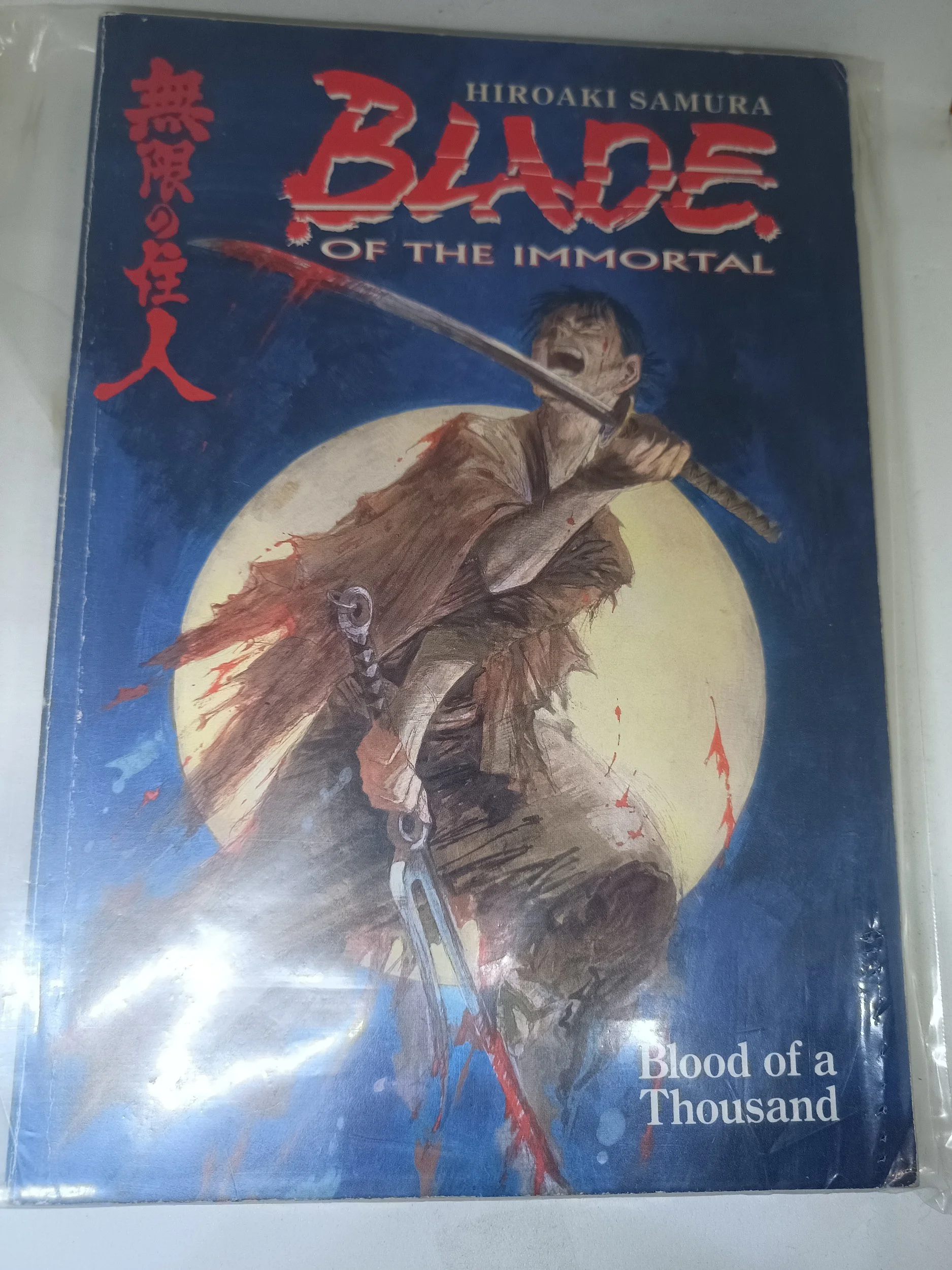
The beginning of one of the greatest manga series ever published and this copy has never been read. Placed in a protective sleeve the moment it was purchased and untouched ever since. Pages crisp, spine uncracked, cover flawless. Preserved by a collector, for a collector.
Where it all begins:
Manji is a ronin warrior cursed with immortality. Kept alive by sacred bloodworms that heal any wound no matter how severe, he cannot die until he has slain one thousand evil men. It is the price of his redemption and it may take a lifetime. When he meets Rin, a sixteen-year-old girl whose parents were murdered by the ruthless leader of the Itto-ryu sword school, their fates become bound together. Rin wants revenge. Manji needs kills. It should be simple. It never is.
Hiroaki Samura's debut volume wastes no time establishing what makes this series unlike anything else in manga. The artwork is extraordinary pencil and ink work of a density and expressiveness that sits closer to fine art illustration than conventional manga. The characters are morally complex from the very first page. And the world of feudal Japan Samura creates feels genuinely dangerous and alive. This is not just a strong opening volume it is the start of a masterwork.
Whether you are starting the series for the first time or completing a full mint run, this is the one to own. All volumes from this collection are available in the shop.
Condition: Used Excellent Condition .
Book Details:
Author: Hiroaki Samura
Publisher: Dark Horse Comics
Edition: 1st Edition
Print Length: 136 pages
Language: English
ISBN-13: 978-1-56971-239-9
Dimensions: 14.61 1.27 20.96 cm
Age Rating: 16+
Volume 2 — Cry of the Worm
The Itto-ryu are introduced more fully. The moral complexity that will define the entire series begins to reveal itself. Samura's battle choreography is already operating at a level that most action manga never reaches.

A mint copy of the second volume in one of the greatest samurai manga series ever published and it has never been read. Placed in a protective sleeve the moment it was purchased and untouched ever since. Pages crisp, spine uncracked, cover flawless. Preserved by a collector, for a collector.
Why this volume matters:
Cry of the Worm is where Blade of the Immortal begins to find its full voice. Samura builds on the explosive opening of Volume 1, deepening both the mythology around Manji's curse and the relationship between Manji and Rin. When Rin stumbles upon the treasured sword of her destroyed dojo in the hands of a wandering ronin, it sets off a chain of events that draws Manji one step closer to his goal of a thousand kills and puts both of them in immediate, brutal danger.
The artwork takes a significant step forward here too. Samura's panelling becomes more cinematic, his choreography sharper, and the character work more assured. This is the volume where you see exactly what kind of series this is going to be and it's a series unlike anything else in manga.
The original Dark Horse single-volume 1st editions are out of print and increasingly scarce in this condition.
Condition: New Mint. Placed in a protective sleeve immediately upon purchase by a private collector and never removed. Unread, unhandled, spine uncracked, pages pristine.
Book Details:
Author: Hiroaki Samura
Publisher: Dark Horse Comics
Edition: 1st Edition (1999)
Print Length: 176 pages
Language: English
ISBN-13: 978-1-56971-300-6
Dimensions: 14.61 1.27 20.96 cm
Age Rating: 16+
Volume 3 — Dreamsong
Deeper into the world of Edo-period Japan, deeper into the characters. Samura renders period costume and architecture with an obsessive historical accuracy that adds tremendous weight to every scene.

Dreamsong is where Samura begins to crystallise the themes of honor, love, duty, and what forces us to keep living that will define the rest of the series. At the centre of this volume is Makie Otono-Tachibana a natural-born killer bred to be a geisha, supremely gifted with a sword, arguably more dangerous than Manji himself. Her infatuation has led her to a life of wrong choices, and the collision between her and Manji is one of the finest character studies in the whole series. Samura makes it clear there will be no clean resolution, no easy redemption just two people trapped by the lives they've been given, fighting anyway.
The original Dark Horse single-volume editions are out of print and increasingly scarce in this condition.
Condition: New Mint. Placed in a protective sleeve immediately upon purchase by a private collector and never removed. Unread, unhandled, spine uncracked, pages pristine.
Book Details:
Author: Hiroaki Samura
Publisher: Dark Horse Comics
Edition: 1st Edition (1999)
Print Length: 208 pages
Language: English
ISBN-13: 978-1-56971-357-0
Dimensions: 14.61 1.27 20.96 cm
Age Rating: 16+
Volume 4 — On Silent Wings

A mint copy of one of the most celebrated and pivotal volumes in the entire Blade of the Immortal series and it has never been read. Placed in a protective sleeve the moment it was purchased and untouched ever since. Pages crisp, spine uncracked, cover flawless. Preserved by a collector, for a collector.
Why this volume is essential:
On Silent Wings is where the series truly reveals its ambition. Samura sidelines Manji for much of the narrative and focuses instead on the philosophical and emotional heart of the story Rin and Anotsu finally meet face to face for the first time, and it makes for one of the most extraordinary encounters in the whole run. The tension of that single meeting, where the most innocent and most dangerous people in the story share the same space, is the kind of drama that defines a great series.
Samura also sheds new light on Anotsu Kagehisa here showing the depth of his motivation and transforming him from ruthless antagonist into one of manga's most compelling and morally complex characters. It's a volume that changes how you see everything that came before it.
Note: On Silent Wings and On Silent Wings II (Vol. 5) form a single continuous story arc. Both volumes are available in this shop collectors will want to secure them together.
Condition: New Mint. Placed in a protective sleeve immediately upon purchase by a private collector and never removed. Unread, unhandled, spine uncracked, pages pristine.
Book Details:
Author: Hiroaki Samura
Publisher: Dark Horse Comics
Edition: 1st Edition (1999)
Print Length: 176 pages
Language: English
ISBN-13: 978-1-56971-412-6
Dimensions: 14.61 1.27 20.96 cm
Age Rating: 16+
One of the most celebrated volumes in the series. The introduction of Magatsu Taito, a character of enormous complexity who becomes one of the story's most compelling figures.
Volume 5 — On Silent Wings II
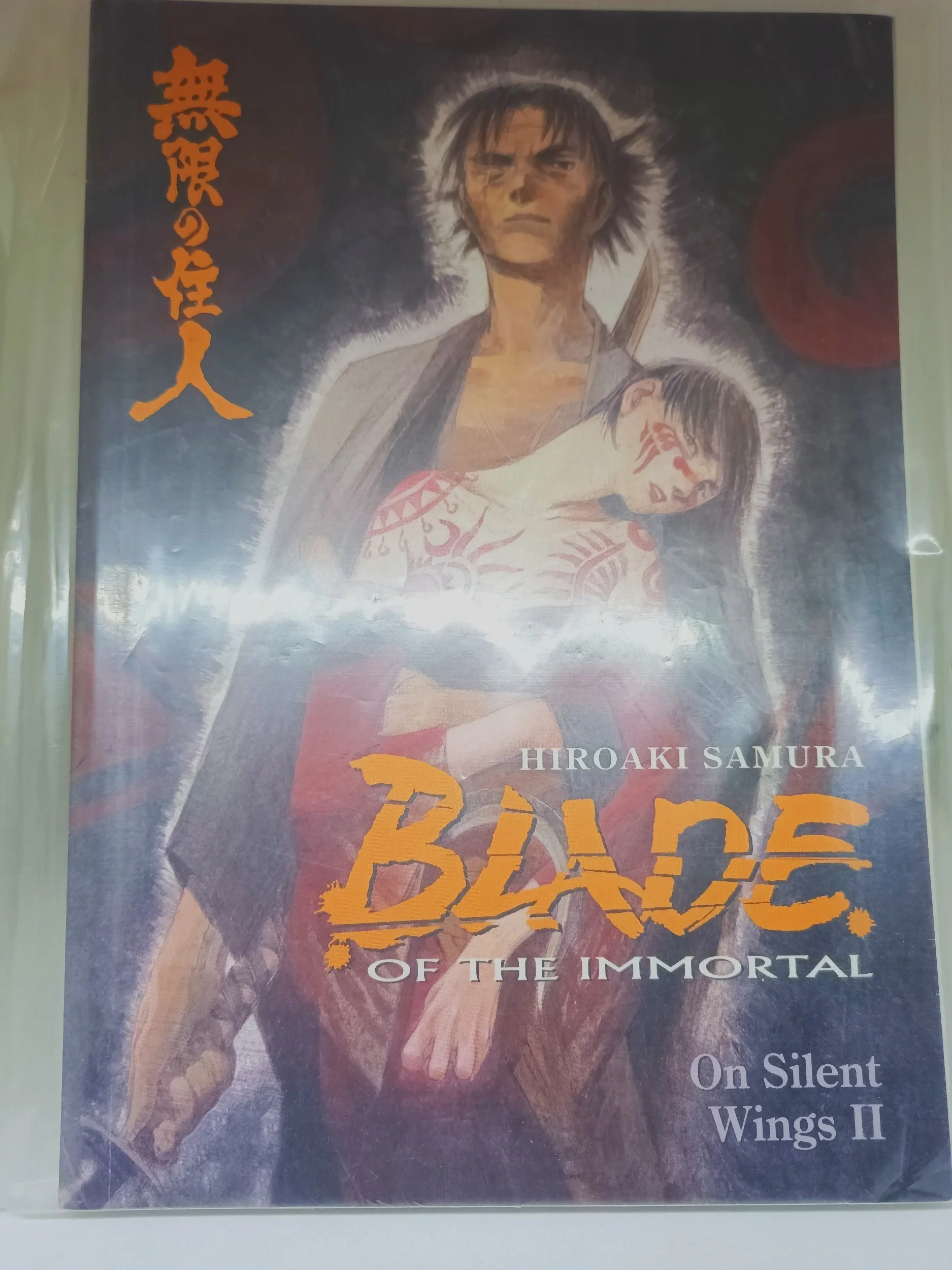
A mint copy of one of the most emotionally rich volumes in the Blade of the Immortal series and it has never been read. Placed in a protective sleeve the moment it was purchased and untouched ever since. Pages crisp, spine uncracked, cover flawless. Preserved by a collector, for a collector.
Why this volume is a turning point:
On Silent Wings II concludes the arc that began in Volume 4, and Samura brings it to a genuinely devastating close. Rin stands face to face with one of her parents' killers a former Itto-ryu assassin now living quietly as a mask maker, with a son of his own to protect. He will take up the sword again to keep his secret buried, and the result is one of the most morally complex and emotionally affecting confrontations in the entire series. Samura shows the full breadth of his ability here raw kinetic action alongside quiet, subtle character moments that linger long after the final page.
Collectors of the original Dark Horse single-volume run consistently rate the On Silent Wings arc among the very best in the series. These 1st editions are out of print and increasingly scarce in this condition.
Condition: New Mint. Placed in a protective sleeve immediately upon purchase by a private collector and never removed. Unread, unhandled, spine uncracked, pages pristine.
Book Details:
Author: Hiroaki Samura
Publisher: Dark Horse Comics
Edition: 1st Edition (2000)
Print Length: 184 pages
Language: English
ISBN-13: 978-1-56971-444-7
Dimensions: 14.61 1.27 20.96 cm
Age Rating: 16+
The continuation of one of the series' most emotionally intense arcs. Samura at his most devastating as a storyteller.
Volume 6 — Dark Shadows

A mint copy of one of the most pivotal volumes in the Blade of the Immortal series and it has never been read. Placed in a protective sleeve the moment it was purchased and untouched ever since. Pages crisp, spine uncracked, cover flawless. Preserved by a collector, for a collector.
Why this volume is a turning point:
Dark Shadows is where Samura dramatically changes the formula of the series. The Itto-ryu have grown politically powerful after destroying rival sword schools across Japan and now they face a deadly new threat: the Akagi, a shadowy organisation built from survivors of the dojos they crushed, sworn to bring Anotsu down. The scope broadens significantly, the politics deepen, and Samura proves he can handle a large ensemble cast just as masterfully as a two-person road story. This is the volume where Blade of the Immortal truly grows into something larger than itself.
The original Dark Horse single-volume 1st editions are out of print and increasingly scarce in this condition.
Condition: New Mint. Placed in a protective sleeve immediately upon purchase by a private collector and never removed. Unread, unhandled, spine uncracked, pages pristine.
Book Details:
Author: Hiroaki Samura
Publisher: Dark Horse Comics
Edition: 1st Edition (2000)
Print Length: 192 pages
Language: English
ISBN-13: 978-1-56971-469-0
Dimensions: 14.61 1.27 20.96 cm
Age Rating: 16+
The world expands. New fighters, new philosophies, new complications in the central revenge narrative. The artwork grows richer with every volume.
Volume 7 — Heart of Darkness

A mint copy of one of the most celebrated volumes in the entire Blade of the Immortal series and it has never been read. Placed in a protective sleeve the moment it was purchased and untouched ever since. Pages crisp, spine uncracked, cover flawless. Preserved by a collector, for a collector.
Why this volume is essential:
Heart of Darkness is where the series truly opens up. Rin and Manji's uneasy alliance with the Mugai-ryu a band of state-sponsored assassins with their own ruthless agenda forces both characters to confront exactly what they're willing to compromise in pursuit of vengeance. Hyakurin, one of the most compelling characters in the whole run, takes centre stage here for the first time, and Samura uses the expanded cast brilliantly. It's darker, more politically charged, and more emotionally layered than anything that came before it in the series.
This is a landmark volume in a landmark series. The original Dark Horse single-volume 1st editions are increasingly scarce in mint condition out of print and only available through secondary markets.
Condition: New Mint. Placed in a protective sleeve immediately upon purchase by a private collector and never removed. Unread, unhandled, spine uncracked, pages pristine.
Book Details:
Author: Hiroaki Samura
Publisher: Dark Horse Comics
Edition: 1st Edition (2001)
Print Length: 240 pages
Language: English
ISBN-13: 978-1-56971-531-4
Dimensions: 15.24 1.91 21.59 cm
Age Rating: 16+
Widely considered one of the most prized volumes by collectors. Intense, violent, beautiful. A turning point in the series that changes everything that follows.
Volume 8 — The Gathering

A mint copy of one of the most gripping turning points in the entire Blade of the Immortal series and it has never been read. Placed in a protective sleeve the moment it was purchased and untouched ever since. The original price ticket from the shop where it was bought over 20 years ago is still attached. Pages crisp, spine uncracked, cover flawless. Preserved by a collector, for a collector.
Why this volume is a key piece:
The Gathering is where the series shifts into a new gear entirely. Manji and Rin's uneasy alliance with the Mugai-ryu has collapsed, and Rin must now attempt to pass through the Shogun's checkpoints alone without Manji, one of the most wanted men in all Japan. When Manji discovers she has gone, he faces an impossible choice: storm the checkpoint by force, or leave Rin to face Anotsu and his killers on her own. The scale broadens, the danger becomes more political, and Samura begins to show just how far he's willing to push both of his leads.
A pivotal volume, in the best possible shape. The original Dark Horse single-volume editions are increasingly scarce in mint condition out of print and only available through secondary markets.
Condition: New Mint. Placed in a protective sleeve immediately upon purchase by a private collector and never removed. Unread, unhandled, spine uncracked, pages pristine. Original shop price ticket still attached.
Book Details:
Author: Hiroaki Samura
Publisher: Dark Horse Comics
Edition: 1st Edition (2001)
Print Length: 208 pages
Language: English
ISBN-13: 978-1-56971-546-8
Dimensions: 14.61 1.32 20.98 cm
Age Rating: 16+
The forces at the heart of the story begin to converge. Samura's crowd and battle scenes are extraordinary feats of compositional management.
Volume 9 — The Gathering II

A mint copy of one of the most tightly constructed volumes in the entire Blade of the Immortal series and it has never been read. Placed in a protective sleeve the moment it was purchased and untouched ever since. Pages crisp, spine uncracked, cover flawless. Preserved by a collector, for a collector.
Why this volume stands out:
The Gathering II picks up exactly where Volume 8 left off, and Samura structures it in two clean halves Manji's brutal confrontation through to its conclusion, then Rin's desperate and dangerous attempt to pass through the Shogun's checkpoints alone to pursue Anotsu. Falsely implicated in a savage murder, hunted by the authorities, and separated from Manji, Rin has never been more vulnerable and Samura has never made her more compelling. It's one of the most suspenseful sequences in the whole series.
The original Dark Horse single-volume 1st editions are out of print and increasingly scarce in this condition.
Condition: New Mint. Placed in a protective sleeve immediately upon purchase by a private collector and never removed. Unread, unhandled, spine uncracked, pages pristine.
Book Details:
Author: Hiroaki Samura
Publisher: Dark Horse Comics
Edition: 1st Edition (2002)
Print Length: 216 pages
Language: English
ISBN-13: 978-1-56971-560-4
Dimensions: 14.61 1.32 20.98 cm
Age Rating: 16+
The continuation. Few manga artists can sustain this level of intensity across hundreds of pages without it feeling exhausting — Samura does it with apparent ease.
Volume 10 — Secrets

A mint copy of one of the most gripping volumes in the Blade of the Immortal run and it has never been read. Placed in a protective sleeve the moment it was purchased and untouched ever since. Pages crisp, spine uncracked, cover flawless. Preserved by a collector, for a collector.
Why this volume stands out:
Secrets is where Samura splits the narrative in two and pulls it off brilliantly. Anotsu Kagehisa takes centre stage journeying to a remote mountain dojo where the welcome is anything but warm, and where the challenge to prove himself runs deeper than it first appears. Meanwhile, Manji is recovering from a battle that left him literally in pieces, and Rin is still missing, still hunting. The tension across both threads is relentless, and Samura's pacing here is among his most assured in the whole series.
The original Dark Horse single-volume editions are out of print and increasingly scarce in this condition only available through secondary markets.
Condition: New Mint. Placed in a protective sleeve immediately upon purchase by a private collector and never removed. Unread, unhandled, spine uncracked, pages pristine.
Book Details:
Author: Hiroaki Samura
Publisher: Dark Horse Comics
Edition: 1st Edition (2002)
Print Length: 232 pages
Language: English
ISBN-13: 978-1-56971-746-2
Dimensions: 14.66 1.52 20.96 cm
Age Rating: 16+
The aftermath of events that have been building for nine volumes. Character revelations that recontextualise everything that has come before.
Volume 11 — Beasts

One of the most emotionally powerful volumes in the entire Blade of the Immortal series and this copy has never been read. Placed in a protective sleeve the moment it was purchased and untouched ever since. Pages crisp, spine uncracked, cover flawless. Preserved by a collector, for a collector.
Why this volume is essential:
Beasts is widely regarded as a standout entry in the series, and for good reason. Samura steps away from Manji almost entirely and focuses on the captured assassin Hyakurin delivering some of the most harrowing and emotionally raw storytelling in the whole run. Rather than using darkness for shock value, Samura makes it feel vivid and real, exploring human endurance and resilience in ways that stay with you long after the final page. Collectors consistently rank this among the most affecting volumes Samura ever produced.
The original Dark Horse single-volume editions are increasingly hard to find in this condition out of print and only available through secondary markets.
Condition: New Mint. Placed in a protective sleeve immediately upon purchase by a private collector and never removed. Unread, unhandled, spine uncracked, pages pristine.
Book Details:
Author: Hiroaki Samura
Publisher: Dark Horse Comics
Edition: 1st Edition (2002)
Print Length: 192 pages
Language: English
ISBN-13: 978-1-56971-741-7
Dimensions: 14.73 1.27 21.08 cm
Age Rating: 16+
A title that describes the moral territory as much as any literal content. Everyone in Blade of the Immortal is, in some sense, a beast — shaped by violence, seeking to transcend it, failing, trying again.
Volume 12 — Autumn Frost

A genuinely difficult volume to find in this condition and this copy has never been read. Placed in a protective sleeve the moment it was purchased and untouched ever since. Pages crisp, spine uncracked, cover flawless. Preserved by a collector, for a collector.
Why this volume is a standout:
Autumn Frost is widely praised as one of the most focused and ferocious entries in the entire series. Samura strips the story back to its most brutal essentials Manji and Magatsu hunting the one-handed killer Shira through feudal Japan, while Shira hunts right back. The result is lean, relentless, and visually stunning. The fighting is imaginative and beautifully choreographed, full of the dark wit that makes Samura's work unlike anything else in manga.
Collectors of the original Dark Horse single-volume run will know how scarce these are becoming in mint condition out of print and only available through secondary markets, this is a genuine find.
Condition: New Mint. Placed in a protective sleeve immediately upon purchase by a private collector and never removed. Unread, unhandled, spine uncracked, pages pristine.
Book Details:
Author: Hiroaki Samura
Publisher: Dark Horse Comics
Edition: 1st Edition (2003)
Print Length: 232 pages
Language: English
ISBN-13: 978-1-56971-991-6
Dimensions: 14.73 1.27 21.08 cm
Age Rating: 16+
One of the rarest in the collection and priced accordingly. Samura's artwork in this period is at its most refined — the linework has a maturity and confidence that takes your breath away.
Volume 13 — Mirror of the Soul

One of the most critically acclaimed volumes in the entire Blade of the Immortal saga and this copy has never been read. Placed in a protective sleeve the moment it was purchased and untouched ever since. Pages crisp, spine uncracked, cover flawless. Preserved by a collector, for a collector.
Why this volume stands apart:
Mirror of the Soul is widely regarded as a turning point in the series. Samura steps away from Manji almost entirely, placing the focus squarely on Anotsu Kagehisa and the result is some of the most emotionally complex storytelling in the whole run. Rin and Anotsu share scenes of real weight, and Samura's artwork is at its most expressive and assured. Readers and critics consistently rank this among the very best volumes in the series.
The original Dark Horse single-volume editions are increasingly scarce in this condition. Out of print and only available through secondary markets, a mint 1st edition is a genuine collector's piece.
Condition: New Mint. Placed in a protective sleeve immediately upon purchase by a private collector and never removed. Unread, unhandled, spine uncracked, pages pristine.
Book Details:
Author: Hiroaki Samura
Publisher: Dark Horse Comics
Edition: 1st Edition (2004)
Print Length: 256 pages
Language: English
ISBN-13: 978-1593072186
Dimensions: 14.48 1.52 21.08 cm
Age Rating: 16+
The series moves into extraordinary territory, both narratively and visually. A volume that rewards close, slow reading.
Volume 14 — Last Blood

A genuine 1st edition of Last Blood and it has never been read. Placed in a protective sleeve the moment it was purchased and untouched ever since. Pages crisp, spine uncracked, cover flawless. Preserved by a collector, for a collector.
Why this volume matters:
The original Dark Horse single-volume editions of Blade of the Immortal are increasingly hard to find in this condition. Out of print and now only available through secondary markets, a mint 1st edition is a genuine find particularly in the mid-series run where storylines intensify and print runs were smaller.
Volume 14 sits at a pivotal point in the saga. Rin and Manji are reunited. The Itto-ryu are regrouping. Samura's draftsmanship is as uncompromising as ever brutal, intricate, and unmistakably his own. An essential volume in the best possible shape.
Condition: New Mint. Placed in a protective sleeve immediately upon purchase by a private collector and never removed. Unread, unhandled, spine uncracked, pages pristine.
Book Details:
Author: Hiroaki Samura
Publisher: Dark Horse Comics
Edition: 1st Edition (2005)
Print Length: 256 pages
Language: English
ISBN-13: 978-1593073213
Dimensions: 14.68 1.57 20.93 cm
Age Rating: 16+
The story continues to build toward its vast, tragic conclusion. Each of these volumes is a chapter in one of the genuinely great extended narratives in the history of popular fiction.
All of these volumes are 1st edition. All are brand new and mint. I have kept them this way because I believe they deserve it — because the art inside them deserves to exist in the best possible condition for as long as possible. These are not just things to read and put on a shelf. They are cultural artefacts.
Manga Today: A Global Phenomenon Still Growing
Let me be clear about the scale of what manga has become, because I think even many fans do not fully grasp it.
The global manga market is enormous and still expanding rapidly. In recent years the international market for manga has grown at a pace that has surprised even industry insiders, driven partly by the explosion in anime adaptations on streaming platforms, partly by the pandemic-era surge in reading, and partly by the simple fact that manga's storytelling quality is so consistently high that once someone discovers the medium they tend to go deep very quickly.
Titles like Jujutsu Kaisen, Demon Slayer, Chainsaw Man, and My Hero Academia have introduced tens of millions of new readers to manga over the past several years. Many of those readers, once they have finished the titles that first hooked them, start exploring backwards — into the classic series of the 1990s and 2000s, into the manga that laid the foundations for what they love. That is how people find Blade of the Immortal. That is how new generations discover Samura.
This is why preserving first editions matters. The readers of 2030 and 2040 — the people who will come to manga through anime they watched as teenagers, who will want to read the original source material in its best form — they will want these books. They will want to hold the English first editions that introduced Western audiences to these works. Scarcity and condition will determine value, both financial and cultural.
I have always believed that the things worth preserving are the ones that carry genuine human achievement in them. Every page of Blade of the Immortal carries Hiroaki Samura's draftsmanship, his storytelling intelligence, his obsessive historical research, his moral seriousness, his love for the medium he works in. Preserving these volumes is preserving all of that.
Why This Collection Matters
I am not a passive collector. I do not simply acquire things and lock them away. I put them into the hands of people who will love them, which is why these volumes are available through my shop. Some will go to collectors who will continue to preserve them. Some will go to readers who will actually open them — carefully, reverently — and discover what Samura created. Both outcomes are good. Both are part of the ongoing life of these books.
Manga has given me something that very few art forms can: an entire visual world built from line and imagination, available in a form you can hold in your hands, carry with you, return to again and again. The artwork rewards repeated looking. You notice something new every time — a piece of background detail, a subtle shift in a character's expression, a compositional choice that perfectly mirrors the emotional content of the scene.
Hiroaki Samura spent almost twenty years of his life drawing Blade of the Immortal. Twenty years of his time, his craft, his vision. The least I can do is make sure the work survives in the best possible condition.
Browse the full Blade of the Immortal collection here: https://retrosheep.com/shop/books-magazines/japanese-manga
Every volume listed is 1st edition, brand new and mint. These are rare. They will not be available forever.