Retro VHS & DVD Films — Cult Classics Worth Saving in 2026 | Retrosheep
TELL THE TV LICENCE MAN TO GET STUFFED — YOUR PHYSICAL MEDIA IS WAITING

CULT CLASSIC MOVIES
There's a quiet revolution happening in living rooms across Britain. People are digging VHS players out of lofts. Car boot sales are being raided for DVD box sets. Charity shop shelves are being stripped of old tapes that sat untouched for a decade. Folks are plugging ancient Panasonic video recorders back into their televisions, pressing play, and remembering exactly what it felt like to actually own a film — not rent it from a faceless server for £9.99 a month until the platform decides to remove it.
Here at Retrosheep in Blackwood, South Wales, we've been feeling this shift in the culture for a while. We sell retro VHS and DVD from our shop, and the interest has been building steadily. People are tired. Tired of streaming platforms removing content without notice. Tired of paying multiple subscriptions and still not finding anything worth watching. Tired of buffering, geo-restrictions, algorithm-driven homogenised content, and — for those of us in the UK — the increasingly indefensible situation of being charged a £174.50 annual television licence fee for the privilege of watching shows we increasingly can't stand.
We actually wrote a song about it. It's called TV Licence Man, and it pretty much covers the feeling. You can find Retrosheep's music at retrosheep.com/music. Give it a listen.
Physical media doesn't need a subscription. It doesn't need a Wi-Fi connection. It doesn't need a licence. It doesn't need your data. It doesn't buffer at the best bit of the film. It doesn't get removed from your library because the rights deal expired. You press play and it plays. Every time. When the internet goes down — and it does go down — you'll always have your physical collection to fall back on. You will never be bored. You will never be held hostage by a platform.
THE PHYSICAL MEDIA REVIVAL — THIS IS ACTUALLY HAPPENING
VHS and DVD collecting is not a niche hobby in 2026. It has become a mainstream countercultural movement, and the numbers back it up. Global sales of physical media players increased significantly throughout 2024 and into 2025, driven primarily by people in the 25–45 age bracket rediscovering formats they grew up with. Charity shops and car boots are consistently reporting higher demand for VHS tapes and DVD box sets than at any point in the previous ten years. Specialist physical media shops are opening. Online communities dedicated to VHS collecting have memberships in the tens of thousands.

Hackers - VHS Tape - Cult MovieFilm - Sci Fi Computers Tech 90s Retro Vintage
The streaming model is fracturing under the weight of its own contradictions. Netflix, Disney+, Prime Video, Apple TV+, Paramount+, Now TV, BritBox — the average British household needs multiple simultaneous subscriptions to access the content it wants, and even then the catalogue shifts constantly beneath them. A film you watched last month may be gone this month, licensed to a different platform, or simply removed because the algorithm decided it wasn't pulling enough engagement. You don't own anything. You rent access to a rotating library that someone else controls.
![The Trap Door - Watch Out for That Nasty Stuff - 13 Scary Episodes) VHS Video Tape Retro [VHS Coloured Tab] SUPER RARE](https://images.squarespace-cdn.com/content/v1/6407a187a21d59729c0be1da/395d6ba5-bd7b-4652-ab8c-2c5f1b9b011c/processed_IMG_20250118_174028_690%7E2.jpg)
SUPER RARE - The Trap Door (13 Scary Episodes) VHS Video Retro, U [VHS Coloured Tab]
With a VHS tape or a DVD, there is no platform to go bust. There is no subscription to cancel. There is no algorithm deciding what you're allowed to watch and when. There is no content expiry date. The film on that disc or tape is yours, it's physical, it exists in your home, and it will still be there in thirty years when every streaming service currently operating has been merged, acquired, sunset, or simply gone. The internet can and does go down — storms, outages, ISP failures, infrastructure problems. When it does, your VHS collection keeps working. Solid state physical media is the ultimate fallback, and people are starting to remember that.
VHS PLAYERS AND DVD PLAYERS — THE GREAT REVIVAL
Everywhere you look, people are giving old hardware a new lease of life. VHS players that were donated to charity shops or left at the tip five years ago are now sought-after items. A working VCR with a clean head in good condition regularly sells for £20–£50 on eBay and Facebook Marketplace. People are descaling them, replacing belts, cleaning the tape path, and setting them back up in the living room. There are active communities online dedicated to VCR maintenance, repair, and head-cleaning, with tutorial videos racking up hundreds of thousands of views.
The same is true for DVD players. The upscaling DVD player — a player that processes standard definition DVD output and presents it at near-HD quality — has become a popular purchase for those who want their physical DVD collection to look its best on a modern television. Brands like Panasonic, Pioneer, and Oppo built players capable of exceptional picture quality, and second-hand units are actively being tracked down and purchased by people who know what they're looking for.

Original Harrison Ford (Actor), Rutger Hauer (Actor), Ridley Scott (Director) Used Good Condition - MAKE US AN OFFER BELOW !
VHS has a specific visual quality that cannot be reproduced digitally — the soft edges, the tracking artefacts, the particular saturation of magnetic tape imagery. For horror films especially, this quality is not a bug, it's a feature. Many horror directors of the 1980s and 90s knew their films would be watched on tape, and composed their cinematography accordingly. The grain, the imperfection, the slight visual decay of VHS — it adds atmosphere that a clinical 4K stream simply cannot replicate. This is why VHS has a dedicated following among horror collectors that goes beyond nostalgia. It genuinely looks different. For some films, it looks better.
WHY MANGA AND ANIME VHS IS THE RAREST PHYSICAL MEDIA OF ALL

If you're a collector looking for the most valuable, the most sought-after, and the most likely to appreciate in value category within the physical media world right now, the answer is Japanese anime on VHS. Specifically: western release VHS tapes of 1980s and 1990s anime and manga films, released in the UK and US in limited quantities, many of which were never reissued on DVD or Blu-ray and exist only in physical tape form.
The UK release window for anime on VHS was narrow — roughly 1990 to 2000, primarily through Manga Entertainment (which launched in the UK in 1991) and later Palm Pictures and Optimum Asia. Titles were released in small quantities, sold through specialist video shops and HMV, and then largely disappeared. The mainstream DVD boom that followed largely ignored the back catalogue of early 90s anime releases, meaning many titles that existed only as VHS in the west have never been given a proper digital release.
The implications for collectors are significant. An original UK Manga Entertainment VHS of Akira, Ghost in the Shell, or Wicked City in good condition with the original sleeve is a collector's item. These tapes are irreplaceable as physical objects. They represent a specific moment in British cultural history — the first time Japanese animation reached mainstream British audiences — and the window to collect them in good condition is closing.
The good news? We have some of them right now in the Retrosheep shop. Let's talk about what we've got.
FILMS FROM THE RETROSHEEP VAULT — FEATURED LISTINGS
Browse the full VHS and DVD section at retrosheep.com/shop/tv-movies — all items are pre-owned, described honestly, and shipped from South Wales via Royal Mail Tracked. Offers are welcome on all VHS and DVD listings — just use the offer button on the listing page.
📼 AKIRA — VHS | RARE UK MANGA ENTERTAINMENT RELEASE 👉 retrosheep.com/shop/p/akira-vhs

RARE Anime - Used Good Condition - MAKE US AN OFFER BELOW !
If you only know one name in this entire list, it's probably this one. Akira (1988) is the film that cracked open the western market for Japanese animation — a landmark of world cinema that still looks extraordinary nearly forty years after its production. Directed by Katsuhiro Otomo and based on his own manga series, Akira is set in Neo-Tokyo 2019, a vast, dystopian megalopolis rebuilt after a mysterious catastrophic explosion destroyed the original city in 1988.
The story follows Kaneda, leader of a motorcycle gang, whose childhood friend Tetsuo develops terrifying and unstable psychic powers after a government experiment goes catastrophically wrong. What follows is a film about power, control, institutional violence, memory, identity, and the horror of transformation — themes that felt prescient in 1988 and feel even more urgent today. The animation is hand-drawn at a level of detail and fluidity that had never been seen before and has rarely been matched since. Over 160,000 individual animation cels were used. Lip sync was achieved by recording the dialogue first and animating to match — the reverse of normal anime production — resulting in mouth movements of unusual accuracy and expressiveness.
In the UK, Akira's VHS release through Manga Entertainment in the early 1990s was a watershed moment. It introduced a generation of British teenagers to the concept of animation as serious adult cinema, not children's entertainment. A genuine UK Manga Entertainment VHS copy in good condition is a collector's item of real significance. If you're building a serious anime VHS collection, this is foundational.
If you love Akira, you should also seek out: Ghost in the Shell (1995, dir. Mamoru Oshii), Patlabor 2: The Movie (1993), Metropolis (2001, also available in our shop on VHS), and the complete Akira manga series by Otomo which ran to six volumes and tells a significantly more expansive version of the story.
📼 PRINCESS MONONOKE — VHS | STUDIO GHIBLI | HAYAO MIYAZAKI 👉 retrosheep.com/shop/p/princess-mononoke-vhs
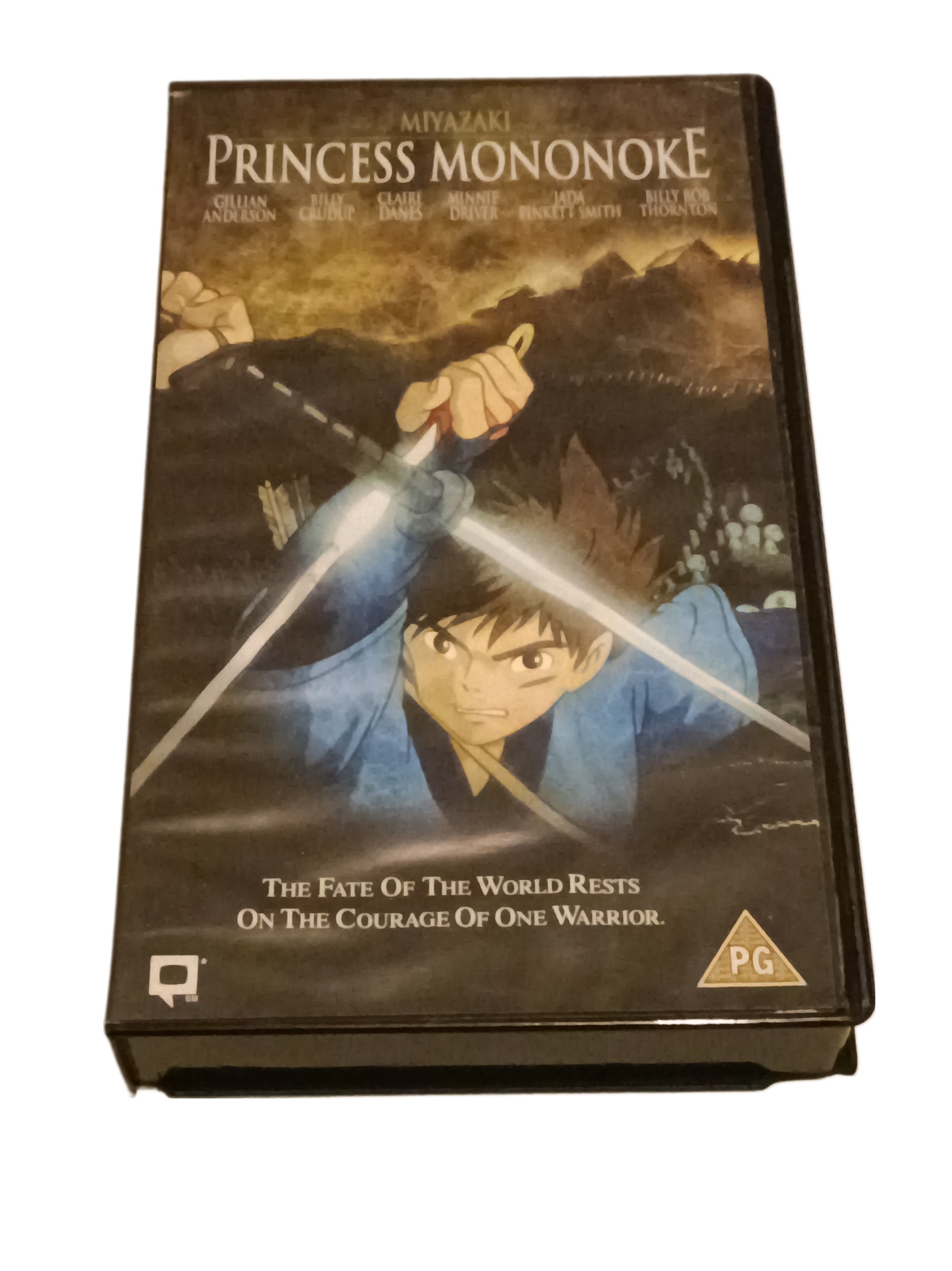
Anime Y'ji Matsuda (Actor), Yuriko Ishida (Actor), Hayao Miyazaki (Director, Writer) - Used Good Condition - MAKE US AN OFFER BELOW !
Princess Mononoke (1997) is a masterwork of animation and one of the greatest environmental films ever made — in any medium, live action or animated. Directed by Hayao Miyazaki and produced by Studio Ghibli, it is set in Muromachi period Japan and follows the young warrior Ashitaka who becomes entangled in a conflict between the gods of a forest and the humans who are consuming it.
The film refuses simple moral positions. The industrialist Lady Eboshi, who is destroying the forest to smelt iron, is also a liberator of outcasts — she employs former prostitutes and cures lepers. The wolf goddess Moro and the boar god Okkoto are magnificent and terrifying. The forest spirit, the Shishigami, is unlike anything else in cinema. Princess Mononoke holds nothing back. It is a film about the irreconcilable conflict between human progress and natural order, and it offers no comfortable resolution.
In Japan, Princess Mononoke was the highest-grossing film in history at the time of its release, overtaking E.T. The Extra-Terrestrial — a record it held until Titanic arrived a few months later. In the west, it remained relatively obscure until DVD releases brought Miyazaki to wider attention. A UK VHS copy in good condition is part of the original wave of western Ghibli releases — historically significant and increasingly hard to source.
If you love Princess Mononoke, explore the rest of the Ghibli catalogue: Nausicaä of the Valley of the Wind (which precedes Mononoke and shares its ecological themes), Spirited Away, My Neighbour Totoro, and Grave of the Fireflies — probably the single most emotionally devastating animated film ever produced.
📼 METROPOLIS — VHS | ANIME | MANGA ENTERTAINMENT 👉 retrosheep.com/shop/p/metropolis-vhs
Metropolis (2001), directed by Rintaro with a screenplay by the legendary Katsuhiro Otomo (writer-director of Akira), is a Japanese anime film loosely based on both Osamu Tezuka's 1949 manga of the same name and the 1927 Fritz Lang silent film that inspired it. The result is a visually extraordinary film that blends a 1930s retro-futurist aesthetic — all art deco architecture, zeppelins, and period clothing — with dazzling modern computer-assisted animation and a deeply melancholy story about a robot girl who doesn't know what she is.
Tima, the robot at the film's centre, is perhaps the most beautifully realised artificial being in anime history — her design deliberately evoking both Fritz Lang's Maschinenmensch and Tezuka's classic Astro Boy aesthetic while telling her own story about consciousness, identity, and what it means to be created for a purpose you don't understand. The film's climax, set against the most unexpected and brilliantly deployed piece of 1920s jazz ever used in a science fiction film, is one of the most emotionally powerful sequences in animation.
For collectors, Metropolis on VHS occupies the sweet spot between historically significant and currently undervalued. It received limited western theatrical distribution and a modest VHS run. It has never had the same cultural penetration as Akira or Princess Mononoke in the UK, which means copies in good condition can still be found at reasonable prices — but that window is closing as anime VHS collecting goes mainstream.
📼 X — ANIME VHS | RARE MANGA | CLAMP 👉 retrosheep.com/shop/p/x

X Anime VHS Video Tape Retro MANGA RARE
X (1996), based on the CLAMP manga series of the same name, is one of the darkest and most visually spectacular anime films ever made. Directed by Rintaro (who also directed Metropolis), X is an apocalyptic fantasy set in modern Tokyo, following Kamui Shirô who must choose the fate of humanity — either the salvation of the planet by allowing human civilisation to be wiped out, or the salvation of humanity at the cost of the earth itself.
The animation is exceptional, particularly in its action sequences — sword fights conducted across the skyline of Tokyo, psychic battles that tear apart buildings and infrastructure, final confrontations of extraordinary scale and visual ambition. The character designs by CLAMP are distinctive and immediately recognisable, with their signature elongated, elegant figures and highly detailed costuming. The film does not soften its apocalyptic premise. Characters you invest in die. The ending offers no comfortable resolution.
The CLAMP X manga series on which this is based ran in Monthly Asuka magazine from 1992 and remains famously unfinished — the series was placed on indefinite hiatus in 2003 and has never resumed. The anime film represents one version of an ending for a story that never officially concluded in its source medium. That alone makes it essential viewing for anyone interested in CLAMP or in apocalyptic anime. A UK VHS copy of X is a genuinely rare find.
📼 TITAN A.E. — VHS | ANIMATED SCI-FI | DON BLUTH & GARY GOLDMAN 👉 retrosheep.com/shop/p/titan-ae-vhs

Anime - Used Good Condition - MAKE US AN OFFER BELOW !
Titan A.E. (2000), directed by Don Bluth and Gary Goldman for 20th Century Fox, is a science fiction animated film that was — at the time of its release — one of the most technically ambitious western animated productions ever attempted. The film blends traditional hand-drawn character animation with extensive computer-generated environments and spacecraft, creating a visual hybrid that was genuinely pioneering for its era.
Set in the far future, Titan A.E. follows Cale Tucker, a young man who discovers that his father has hidden humanity's last hope — a ship called the Titan — somewhere in the galaxy. The film features voice work from Matt Damon, Drew Barrymore, Bill Pullman, John Leguizamo, and Nathan Lane. The visual design, particularly the nebula sequences and the alien spacecraft designs, is spectacular. The Drej — the alien race that destroyed Earth at the film's opening — are rendered as pure energy beings in computer-generated animation that still impresses today.
Titan A.E. bombed at the box office in the US and was responsible for the closure of Don Bluth's animation studio — a historically significant casualty of the animation industry's difficult transition from the hand-drawn golden era to the CG-dominant model that Pixar was simultaneously establishing. As a result, it has never received the cultural reassessment it deserves. The film is better than its reputation. On VHS, it has the visual softness that suits its aesthetic. For collectors interested in the transitional era of western animation — the period between the Disney Renaissance and the CG takeover — Titan A.E. is an essential document.
📀 ICHI THE KILLER — DVD | TAKASHI MIIKE | 18 CERTIFICATE 👉 retrosheep.com/shop/p/ichi-the-killer-dvd

Ichi the Killer - Deranged, perverse and teeth-gnashingly violent, this is a typical Takashi Miike film, replete with brutal sadism and copious blood spilling.
Miike Takashi Used: Very Good
Ichi the Killer (2001) is one of the most infamous films in the career of Japanese director Takashi Miike — which, given that Miike has directed over a hundred films and is not known for restraint, is a statement of some significance. Based on the manga by Hideo Yamamoto, Ichi the Killer is a Yakuza crime film about the hunt for a gang boss called Anjo, told through the competing perspectives of Kakihara — a masochistic enforcer suffering withdrawal symptoms from his absent boss's cruelty — and Ichi, a psychologically shattered killer who functions as an unstoppable weapon for a retired Yakuza.
The film is graphic, confrontational, and deliberately excessive. It is also brilliantly crafted. Miike's direction is precise and purposeful — the violence is not random, it is structured to create specific psychological responses in the viewer, interrogating the relationship between spectatorship and sadism in a way that makes the audience uncomfortable about their own fascination with what they're watching. Tadanobu Asano's performance as Kakihara — with his modified face, his precise mannerisms, and his horrifying warmth — is one of the great character performances in Japanese cinema. Nao Omori as the terrified, weeping Ichi is equally extraordinary.
This is an 18-certificate film and it earns that certificate thoroughly. It is not for everyone. But for fans of extreme Japanese cinema, of Yakuza films, of Takashi Miike's body of work, or of films that genuinely challenge and disturb rather than simply entertain — Ichi the Killer is essential viewing. If you like this, explore the rest of Miike's filmography: Audition (1999) is probably his most celebrated and disturbing film; Visitor Q (2001) is perhaps his most provocative; Dead or Alive (1999) is one of the great Yakuza films.
📀 FREEZE FRAME — DVD | LEE EVANS | PSYCHOLOGICAL THRILLER 👉 retrosheep.com/shop/tv-movies

FREEZE FRAME Staring Lee Evans (Actor), Rachael Stirling (Actor), John Simpson (Director, Writer) Rated: Suitable for 15 years and over
And now for the one that surprises people every single time. Freeze Frame (2004), directed by John Simpson, stars Lee Evans — yes, that Lee Evans, the comedian with the sweaty suits and the greatest live audiences in British comedy history — in a role that is as far from his stand-up persona as it's possible to travel.
Evans plays Sean Veil, a man acquitted of a notorious triple murder who is so convinced he will be framed for further crimes that he begins filming every second of his life. Every room in his house is covered with cameras. He wears cameras on his body. He sleeps with cameras running. He obsessively catalogues and stores hundreds of VHS tapes of his own existence, a perfect alibi for every moment of every day — until the day the police come calling about a new murder, and the one tape that would prove his innocence is missing.
Evans shaved both his head and his eyebrows for the role — despite being warned they might not grow back. The result is a performance of searing intensity from a man we associate almost exclusively with physical comedy. His Sean Veil is a profoundly sympathetic figure: frightened, isolated, intelligent, and trapped in a logic of his own construction that has made him both safer and more imprisoned than any cell could achieve. Variety's David Rooney compared director Simpson's visual style to early David Fincher. The Los Angeles Times described the film as a stylish, dystopian allegory about Orwellian surveillance and the consuming nature of technology — a reading that has only become more resonant in the two decades since its release.
Here's the thing about Freeze Frame: almost nobody has seen it. It earned just over £38,000 at the UK box office on release, was released on DVD in January 2005, and largely disappeared. It is not the kind of film that gets recommended by Netflix algorithms. It is not the kind of film that trends on social media. It is exactly the kind of film that sits in a DVD case on a shelf in a retro shop in South Wales, waiting for someone who knows what they're looking for.
Now you know.
The film has an obvious additional resonance with the physical media theme of this blog post — a story about a man whose entire security rests on the preservation of physical video tapes, and whose crisis begins when one tape goes missing. He didn't stream it. He didn't trust the cloud. He had the tape in his hand, and then he didn't. If Sean Veil had trusted a streaming service with his life, the film would be about twenty minutes long.
We also have a song that feels thematically aligned — TV Licence Man, an original Retrosheep track that captures the frustration of paying for media you don't choose, being told what you can and can't watch, and the liberating feeling of picking up a physical disc and watching exactly what you want, when you want, with no subscription, no algorithm, and no one's permission. You can find it at retrosheep.com/music.
PHYSICAL MEDIA IS AN ACT OF RESISTANCE
Streaming platforms have made watching films more convenient and more precarious simultaneously. You can watch almost anything — right up until the moment you can't, because it's been removed, licensed away, price-increased out of reach, or simply deleted from a catalogue that a corporation controls entirely. The history of home cinema is littered with films that were available on one format and never made the transition to the next: films that existed on LaserDisc but never reached DVD; films that were released on VHS but skipped DVD entirely; films that had brief streaming windows and are now effectively inaccessible. Physical media is the only format that preserves these films permanently and puts their preservation in the hands of the people who care about them.
When you buy a VHS tape or a DVD, you are not just purchasing a film. You are preserving it. You are ensuring it continues to exist in a form that does not depend on a server, a subscription, a licence deal, or a corporation's continued existence. You are the archive. Your shelf is the vault.
And when the internet goes down — when the power cuts out, when the ISP fails, when the router dies, when the streaming app crashes — you reach for the disc, and you press play.
All of the titles mentioned above are available in the Retrosheep shop at retrosheep.com/shop/tv-movies, alongside DVDs and VHS across horror, action, Japanese cinema, period drama, sport, sci-fi, cult classics, and more. Offers are welcome — just use the offer button on any listing. Every item is pre-owned, described honestly, and ships from Blackwood, South Wales via Royal Mail Tracked.
Delivery: Royal Mail Fixed Rates — UK Standard £3.60 Tracked 48hr. Payments: PayPal (recommended, clears instantly). Credit & Debit Cards via Stripe.
Retrosheep — Handmade in Wales since 2006. Blackwood, South Wales.retrosheep.com | retrosheep.com/shop/tv-movies | retrosheep.com/music